


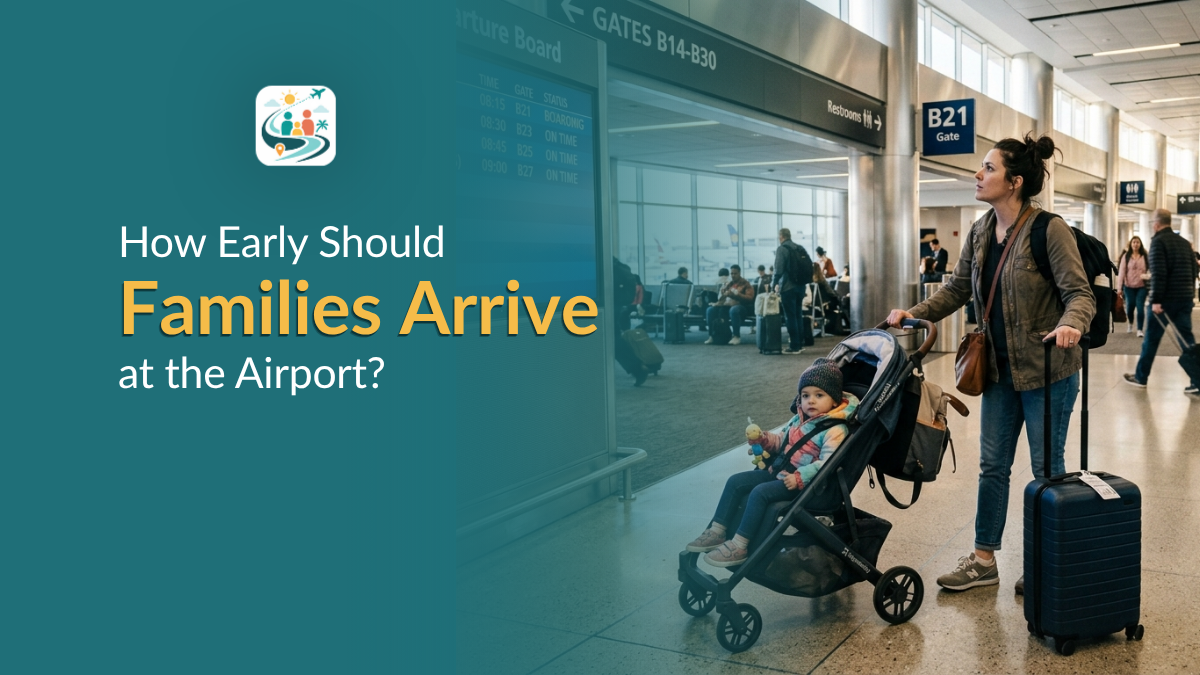
Traveling with kids changes everything. I still remember standing in a security line with a stroller, a crying toddler, and a backpack full of snacks, silently panicking about whether we’d already blown our timing. The flight hadn’t left yet, but the stress was very real — lines moved slowly, my son needed the bathroom the moment we reached the front of the queue, and boarding announcements kept cutting through the noise like a countdown clock. That’s when it hit me: airport timing for families is a completely different game than it is for solo travelers.
Most parents don’t search “how early should families arrive at the airport” out of curiosity. They search because they’re afraid of missing a flight, rattling their kids, or kicking off a vacation in full chaos mode. Based on years of traveling with little ones and a careful look at airline timing rules, this guide walks you through exactly how early your family should arrive — so you can stay calm, stay prepared, and actually enjoy the start of your trip.
Why Families Need Extra Time at the Airport
Kids slow things down — and that’s completely okay, it’s just something to plan for. What feels like a five-minute task at home (finding the wipes, changing a diaper, convincing a toddler to put their shoes back on after security) can easily stretch to fifteen minutes in a busy terminal.
Families consistently need extra time for diaper changes and bathroom breaks, strollers and car seats that need to be checked or gate-checked, extra TSA screening for baby food and liquids, snack stops and the inevitable meltdown management, and long terminal walks or inter-terminal trains. Even one or two of these adding a few minutes each can quietly eat your buffer. Arriving early removes the pressure — and when the pressure is off, kids feel it too.
How Early Should Families Arrive for Domestic Flights?
Most airlines recommend arriving 2 hours before departure for domestic flights, and that timing works reasonably well for solo travelers moving fast and light. For families, though, it’s genuinely cutting it close.
Best practice for families: arrive 2.5 hours early.
That extra half hour gives you comfortable room for parking or curb drop-off, check-in and bag drop, security screening, a bathroom and snack stop, and the walk to your gate. On one of our Florida trips, we thought 2 hours was plenty — until the bag drop line alone took 25 minutes. We made it, but just barely, and nobody was happy about it. If you’re flying from a large or unfamiliar airport, go ahead and add another 30 minutes on top of that.
How Early Should Families Arrive for International Flights?
International travel adds several layers that don’t exist on domestic routes — passport checks, longer check-in queues, customs forms, and bag drop cutoffs that close earlier than you’d expect. With a baby or toddler in tow, each of those steps takes longer than the posted estimate.
Safe timing for families: arrive at least 3 hours early, and add 30–60 minutes if you’re traveling with babies or toddlers. Some airlines close check-in as early as 60 to 90 minutes before departure, so always double-check your specific airline’s rules before you leave the house — that detail alone can save your trip.
Important Timing Rules Families Must Know
One of the most common mistakes parents make is planning around the departure time instead of the boarding time. By the time the gate door closes, you should already be seated.
Here’s what actually matters on the clock: bag drop closes early, often 45–60 minutes before departure; check-in counters may close even earlier than that; boarding typically wraps up 10–15 minutes before the listed departure time; and gate doors can close without warning if the flight is ready to push back. If you miss any of these cutoffs, airlines are within their rights to deny boarding — and “we had a toddler meltdown” is not an accepted excuse at the gate, as much as it should be. Arriving early is the only real protection against this.
Does TSA PreCheck or CLEAR Change Family Arrival Time?

TSA PreCheck and CLEAR are genuinely helpful — a shorter, faster security lane makes a real difference when you’re juggling a stroller, a carry-on, and a wiggly two-year-old. But they don’t change the other deadlines that families need to hit.
Neither program affects bag drop deadlines, check-in cutoffs, or boarding rules. Even with the security time savings, families should still plan to arrive at least 2 hours early for domestic flights and 3 hours early for international flights. Faster security is a bonus, not a replacement for an early arrival.
How Holidays and Busy Travel Days Affect Families
Airports hit peak capacity during summer, Thanksgiving, Christmas, New Year’s, spring break, and long holiday weekends — and every single step of the airport process slows down during those periods. Check-in lines back up, security queues stretch around corners, and gates fill fast.
During any busy travel period, add a full extra hour to your arrival time. The crowds affect everything from the parking garage to the gate, and families who don’t plan for it are the ones you see sprinting through terminals with a stroller.
Airport Size Can Change Your Timing
A smaller regional airport can genuinely be faster — shorter lines, easier parking, gates that are a two-minute walk from security. But “smaller” doesn’t mean “instant,” and even small airports have delays.
If you’re flying out of a large or unfamiliar airport, add at least 30 extra minutes to your plan. Families consistently underestimate walking time in big terminals, especially when one child wants to stop at every moving walkway and the other needs a bathroom that turns out to be at the opposite end of the concourse.
Do Children Need ID at the Airport?
For U.S. domestic flights, children under 18 generally don’t need ID — TSA’s rules allow kids to travel without identification as long as an adult with valid ID is present. That said, always verify this with your specific airline before you leave home, since policies can vary.
What can cause a serious delay is a problem with an adult’s ID. Make sure every traveling adult has a valid, accepted form of identification — especially now that REAL ID enforcement is in full effect. A last-minute ID issue at check-in is a stressful situation nobody wants to be in with young kids in tow.
Realistic Family Airport Timeline
Curb to gate tracking performance metrics window calculations.
- 1
Parking or drop-off
Finding a spot, unloading gear
15–30 min 0–30 min in - 2
Check-in + bag drop
Counter queue, tagging bags
20–40 min 30–70 min in - 3
Security screening
Stroller, liquids, baby food checks
20–45 min 50–115 min in - 4
Bathroom + snacks + reset
The unavoidable family pit stop
10–15 min 60–130 min in - 5
Walk or train to gate
Can be 5 min or 25 min
10–20 min 70–150 min in
Add those ranges up and you’re looking at 75 minutes to over 2 hours just from curb to gate — before you’ve even had a chance to sit down. That’s why the recommended arrival windows exist, and why they matter even more for families than they do for anyone else. If you have a stroller, car seat, or a toddler who moves at their own pace, add extra time to every single step on that list.
Expanded Situations Table
A second structured reference covering the timing rules the article mentions:
| Situation | Arrive Before Departure | Stress Level |
|---|---|---|
| Domestic — carry-on only, familiar airport | 2 hrs | Low risk |
| Domestic — checked bags | 2.5 hrs | Comfortable |
| Domestic — toddler or baby | 2.5 – 3 hrs | Add buffer |
| Domestic — large or unfamiliar airport | 3 hrs | Add buffer |
| Domestic — peak / holiday travel | 3.5 hrs | Plan ahead |
| International — standard | 3 – 3.5 hrs | Add buffer |
| International — with toddler or baby | 3.5 – 4 hrs | Plan ahead |
| International — peak + toddler + large airport | 4.5 hrs | Arrive early |
| With TSA PreCheck / CLEAR (security savings only) | Subtract 20–30 min | Helps but not a fix |
Don’t Make These Common Family Airport Mistakes
- Planning for departure time instead of boarding time
- Forgetting that bag drop and check-in close early
- Assuming TSA PreCheck/CLEAR fixes everything
- Not budgeting time for bathroom breaks and snacks
- Ignoring long walks, shuttles, or airport trains to the gate
Final Recommendation for Families
If you want peace of mind, keep it simple:
- Domestic flights: arrive 2.5 hours early
- International flights: arrive 3.5 to 4 hours early
- Busy travel days: add 1 extra hour
Rushing through an airport with young children creates stress that ripples through the whole day. Arriving early keeps everyone — parents included — calmer and more present for the actual trip.

After traveling with kids through small regional airports, massive international hubs, early morning departures, and holiday chaos, one thing has never changed: families always need more time than they think they will. Every extra step adds minutes — a diaper change before security, wrangling snacks out of the bag at the X-ray belt, a bathroom stop that absolutely cannot wait, a stroller to gate-check. None of those things are a big deal on their own, but together they stack up fast. When you arrive with time to spare, even the unpredictable stuff feels manageable.
The safest approach is a simple one: arrive early, build in real buffers, and assume something will slow you down — because at least one thing always does. Flights don’t wait, but kids need patience and room to move at their own pace. Planning extra time isn’t overkill. It’s how you protect your trip and actually start your journey feeling ready.
