


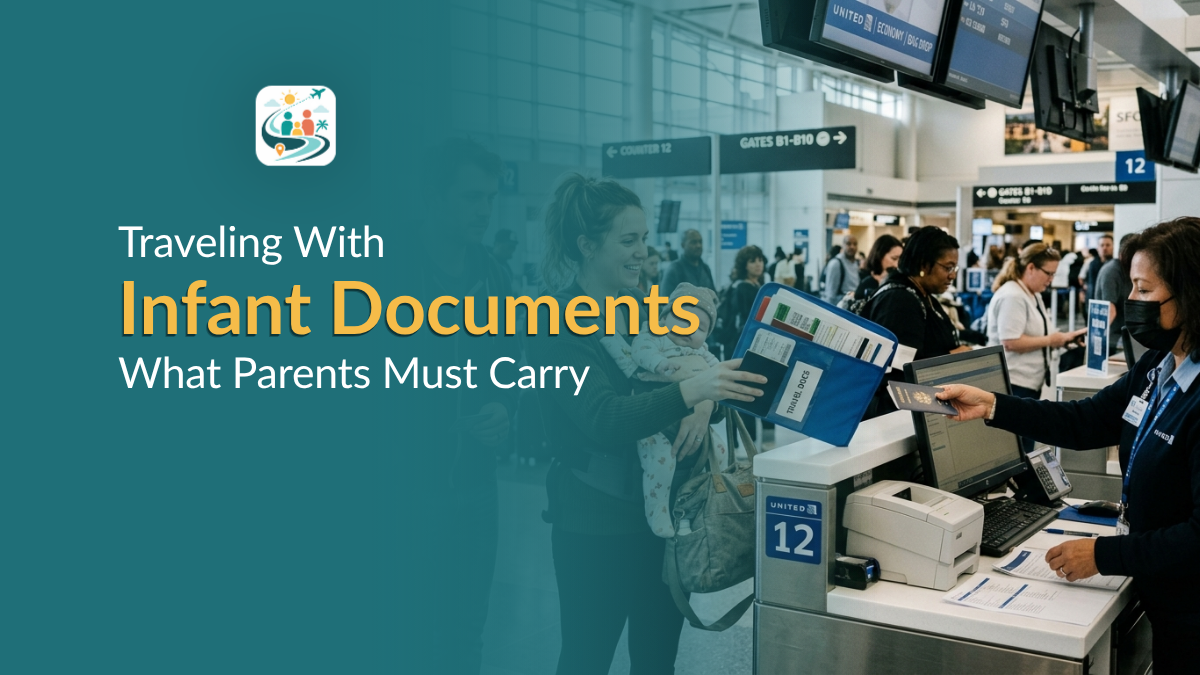
I still remember standing at the check-in counter with my four-month-old strapped to my chest, completely confident we had everything — until the agent asked for proof of her age and I realized our birth certificate was sitting on the kitchen counter at home. We weren’t denied boarding that day, but it was close, and the panic I felt in that moment was enough to make me obsessive about infant travel documents for every trip since. That experience taught me something no travel blog had ever spelled out clearly: airlines can and do ask for infant paperwork, and not having it ready can unravel your entire trip before it starts.
Most parents don’t think about infant travel documents until they’re already in the thick of trip planning — and by then, some documents take weeks to obtain. The rules aren’t always obvious, especially for first-time traveling parents who assume babies don’t need much paperwork. This guide breaks down exactly what to carry, when you need it, and how to stay prepared so the focus stays on your trip and not on a paperwork emergency at the gate.
Quick Tip: Documents Needed When Flying With a Lap Child

Most airlines allow babies under two years old to travel as lap infants, meaning the baby sits on a parent’s lap without needing a separate purchased seat. Airlines will often ask parents to show proof of the baby’s age or identity before allowing travel, so having the right documents within easy reach is essential.
Always carry at least one official document confirming your baby’s birth date. The most commonly accepted options are:
- Birth certificate
- Passport
- Hospital birth record
- Medical records showing birth date
Many first-time parents assume airlines rarely check infant documents. But airline staff can request them at any point — during booking, check-in, or boarding. Keeping infant documents in a dedicated travel folder at the top of your carry-on takes about two minutes to set up. It can save you a genuinely stressful situation at the counter.
Documentation Required for Lap Infants
Most airlines allow babies younger than two years to travel without purchasing a separate seat, but they do expect parents to prove the child’s age if asked. The documents airlines most commonly accept include:
- Original birth certificate
- Copy of birth certificate
- Infant passport
- Government-issued identification
Always keep these documents in your carry-on bag. Never pack them in checked luggage where you can’t reach them quickly. Airport staff may ask for documents during check-in, security screening, or right at the boarding gate.
Airlines pay closer attention to age verification when a child appears close to the two-year cutoff. If your baby is around 18 to 24 months, come prepared with clear documentation. Even if your booking went through without a document check, the gate agent may still ask.
Smart Backup Documents Parents Should Carry

Experienced traveling parents know that backups are just as important as originals. While not always required, having backup copies has saved many families from real travel emergencies:
- Printed copies of all important documents
- Digital copies saved securely on your phone or in cloud storage
- Travel insurance information
- Pediatrician contact details
If an original document is lost or accidentally left in a hotel room, a backup copy gives you something to work with. It’s one of those small preparations that feels unnecessary — until the moment it isn’t.
Proof of Age
Proof of age is one of the most critical documents when traveling with a baby. It’s also the one parents most often forget, because it feels too obvious to mention. Airlines use it to confirm your infant qualifies for lap seating or the child ticket pricing applied during booking. If they can’t confirm it, they have grounds to deny boarding.
The gold standard is a birth certificate. It shows your baby’s full legal name and date of birth in an official format. Some airlines accept a hospital birth record for very young newborns. Those informal documents often aren’t accepted for international travel, so always lead with the birth certificate. Carry both the original and a photocopy. Some airlines won’t accept copies alone, and having both means you’re covered either way.
Special Case: Traveling With a Newborn
Traveling with a newborn before the official birth certificate arrives is more common than you’d think. For domestic travel, some airlines will accept hospital birth records or medical documentation showing the birth date. Policies vary by carrier, so call ahead to confirm. For international travel, a passport is almost always required — even for newborns. Start the application process as early as possible, ideally within the first few weeks of your baby’s life if travel is planned soon.
Passport (For International Flights)
Every infant needs their own passport for international travel. Babies cannot be added to or travel on a parent’s passport. This rule applies in virtually every country. If your family is planning an international trip, the passport application should be one of the first things on your checklist — not an afterthought in the final weeks before departure.
The application process typically requires:
- Completed passport application form
- Baby’s birth certificate
- Passport photos of the baby
- Identification documents of both parents
- Proof of parental relationship
Both parents must normally appear in person when applying for a baby’s passport. This rule exists to protect children and help prevent international child abduction. It can feel like a logistical hurdle, but it’s a non-negotiable step in most cases.
Exceptions When Both Parents Cannot Attend
Life doesn’t always make it easy for both parents to show up at the same appointment, and the passport system does have legal provisions for those situations:
- Form DS-3053 allows one parent to give notarized consent for the other to apply alone
- Form DS-5525 covers situations where one parent cannot be located
- Court custody documents may allow a single-parent application in certain circumstances
Sorting out these forms takes time, so if your situation requires them, start the process well before your travel date. Missing or incomplete paperwork is the most common reason infant passport applications get delayed.
Passport Processing and Urgent Travel
Standard passport processing can take several weeks, and during busy periods it can stretch longer than expected. Expedited services are available if your travel timeline is tight, but even those aren’t instant. Most experienced family travelers recommend applying at least two to three months before any planned international trip — earlier if you can manage it.
Visa Requirements for Infants
Some countries require visas for babies, and the rules depend entirely on your destination and your child’s citizenship. This is one of those details that’s easy to overlook because it feels like a grown-up concern, but infant visa requirements are real and can block entry if you arrive unprepared. Always verify the entry requirements for your specific destination well before booking flights — your country’s foreign affairs or state department website is the most reliable place to check.
Dual Citizenship Warning
Infants with dual citizenship face an added layer of complexity that families sometimes don’t discover until they’re at the border. Some countries require children to enter and exit using a specific passport — typically the passport of that country’s citizenship — and immigration officers in some destinations will request documented permission from both parents before allowing a child to leave. If your baby holds citizenship in more than one country, review the entry and exit laws for every country on your itinerary carefully. Getting this wrong can mean being held at immigration with a tired baby, which is a situation worth spending an afternoon of research to avoid.
Parental Consent

Many countries require documented parental consent when a child travels without both parents present. This applies whether one parent is traveling solo with the baby, or the child is traveling with grandparents, relatives, or another guardian. A parental consent letter proves the absent parent has approved the trip. Without it, immigration officers at many international borders can deny entry or exit.
A complete parental consent letter should include:
- Child’s full name and birth date
- Full names of both parents or guardians
- Travel dates and destination
- Contact information for both parents
- Signatures of both parents
Having the letter notarized is strongly recommended for international travel — a notary stamp adds a level of legal credibility that makes border officers far less likely to ask follow-up questions.
Traveling Alone as a Single Parent
Single parents traveling internationally with a baby should be prepared for additional scrutiny at immigration, particularly in countries that have strict child protection laws. Carrying your custody agreement or a letter from the other parent confirming consent for travel isn’t just helpful — in many destinations it’s effectively required in practice, even if not officially mandated on paper. Being ready with that documentation turns what could be a long conversation at the border into a quick stamp and wave-through.
Traveling With Guardians or Relatives
When a baby travels with grandparents, aunts, uncles, or any adult who isn’t a legal parent, that adult should carry a complete set of supporting documents:
- Signed parental consent letter from both parents
- Copies of both parents’ identification
- Child’s birth certificate
- Guardian’s own identification
These documents allow border officers to quickly confirm the child’s safety and the legitimacy of the travel arrangement, which matters particularly in international travel where child protection screening is thorough.
Traveling With Sole Custody
Parents who have sole legal custody should carry their court custody documents on every international trip. These papers are your proof that you have the legal right to travel with your child without the other parent’s presence or consent, and without them, an immigration officer who asks questions has no way to verify your situation. Keep a certified copy — not just a photocopy — in your travel folder.
Will the Airline Actually Ask for Documentation?

The honest answer is: maybe not every time, but often enough that assuming they won’t is a real gamble. Airlines can request infant documents at any point in the process — ticketing, check-in, security, or boarding — and the staff member you encounter has no obligation to give you the benefit of the doubt if something looks unclear.
Airlines are most likely to check closely when the baby appears close to the two-year lap infant cutoff, when the flight is international, or when the airline’s own policies require stricter age verification as standard. The fact that one airline didn’t ask on your last trip doesn’t mean the next one won’t — carrier policies vary, and staff discretion varies even more.
Canada and Mexico Travel Exception
Children under 16 traveling to Canada or Mexico by land or sea may not require a passport in all cases. Accepted alternatives can include:
- Birth certificate
- Consular Report of Birth Abroad
- Naturalization certificate
That exception applies to land and sea travel only. Air travel to both countries requires a valid passport regardless of age. Always confirm the specific entry requirements before your departure date, since these rules can change.
Bottom Line
The families who travel smoothly with infants are almost always the ones who prepared early. They kept everything organized and easy to reach. Parents who assume they won’t be asked — or who leave paperwork to the last minute — are the ones having a very bad morning at the check-in counter. The safest approach is to carry proof of age on every trip. Bring a passport for any international travel. Pack consent or custody paperwork whenever you’re traveling without the other parent. Build a simple document checklist before every trip. Keep both physical and digital copies of everything important. Put it all somewhere you can reach in under thirty seconds. When your documents are sorted, you get to actually enjoy traveling with your baby — and that’s the whole point.
