



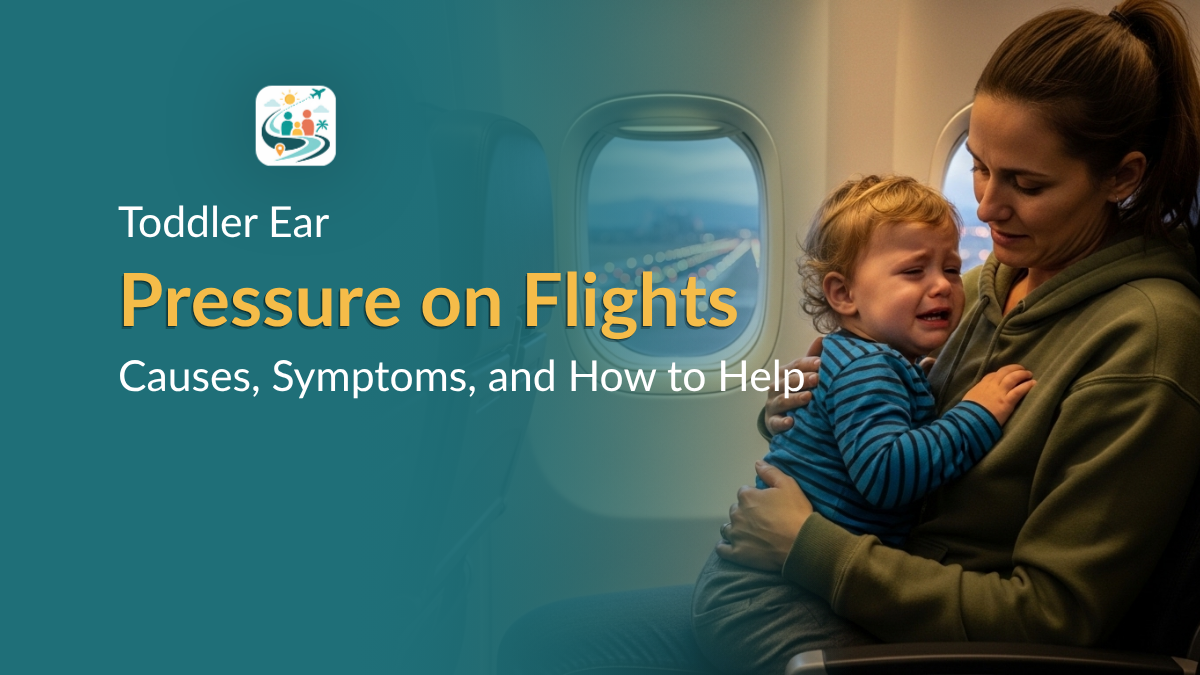
I remember holding a crying toddler during landing, offering drinks that were refused, and wondering if flying was a mistake. Over time, and by following pediatric advice, I learned that toddler ear pressure on flights is very common and usually temporary. With simple preparation and the right timing, parents can reduce pain and feel more confident during air travel. For everything else about the trip, see our complete guide to flying with a baby or toddler.
Key takeaways
- Ear pressure is common in toddlers and is usually temporary.
- Landing is often more painful than takeoff.
- Swallowing and chewing help the ears balance pressure.
- If your toddler cries during landing, it’s normal and can even help.
- The best results come from starting before the plane begins to land.
- Standard techniques sometimes fail — the section below on refusal and crying covers what to do when they do.
What causes toddler ear pressure on flights

Ear pressure happens when the air pressure outside the ear changes faster than the pressure inside. This mostly occurs during takeoff and landing.
Toddlers between 1 and 4 years are more affected because their Eustachian tubes are small and still developing. These tubes connect the middle ear to the back of the throat and equalize pressure when they open. When they don’t open easily, pressure builds and causes pain or a blocked feeling.
For age-specific guidance, see flying with a 1-year-old and flying with a 2-year-old.
Toddlers can’t control this the way adults can. They don’t know how to yawn or swallow on purpose, and some refuse drinks or snacks when they feel upset — which is exactly when you need them to swallow.
Why landing is harder than takeoff
During takeoff, cabin pressure drops relative to the ear. The Eustachian tube vents passively in this direction, which is why most toddlers don’t show much distress going up.
During descent, cabin pressure rises. The tube now has to actively open to let pressure in — the harder mechanical direction. Pressure also changes faster during descent than ascent, which is why landing is consistently worse.
The practical implication: start your preparation well before descent begins, not when your toddler first shows discomfort. Once pressure has built up significantly, the tube becomes harder to open and late intervention is less effective.
Signs your toddler is experiencing ear pressure
- Crying or screaming during landing
- Pulling or rubbing the ears
- Sudden fussiness
- Refusing drinks or snacks
- Trouble settling down
These symptoms are normal and usually improve once the plane levels out or after landing. Most toddlers are fully settled within 30 to 60 minutes of landing. If discomfort continues past 90 minutes, it’s worth noting before any upcoming flights.
How to help your toddler during a flight
Offer drinks during takeoff and landing

Swallowing opens the Eustachian tube. Offer water, milk, or juice. A straw cup often works better than an open cup because it encourages more consistent sipping. For babies too young for a cup, see feeding a baby during takeoff and landing for the same technique by bottle or breast.
Use snacks that require chewing
Chewing works the jaw and promotes swallowing. Any food that requires chewing has the same basic effect — crackers, fruit slices, and similar snacks all work for the same reason.
Use a pacifier if your toddler accepts one
Sucking triggers repeated swallowing without requiring the toddler to actively eat or drink. Offer it if your toddler uses one. Don’t force it.
Keep your toddler upright
An upright position helps the ears adjust. Avoid letting your toddler lie flat during descent. A car seat holds that upright position automatically — see car seats on airplanes.
Keep your toddler awake during landing
More pain is common when toddlers sleep through landing, for two reasons: they swallow less, and they can’t be coached, offered a drink, or easily kept upright. This is the main tradeoff on overnight routes — see red-eye flights with toddlers.
Waking a sleeping toddler mid-flight carries its own risk, though. A child woken mid-sleep-cycle is often more distressed than one left to sleep through discomfort. If your toddler falls asleep close to descent, weigh that tradeoff before waking them. Our guide to helping a toddler sleep on a plane covers how to time sleep so it doesn’t collide with descent.
What helps most by age (1–4 years)
What to do before the plane starts landing
Many parents wait too long. Getting 5 to 6 swallows in before the pressure differential builds gives the ear tubes a head start. On longer routes there’s more than one descent to plan for — see long-haul flights with toddlers.
About 30 minutes before landing:
- Offer drinks
- Prepare snacks
- Move your toddler into an upright position
When descent begins:
- Encourage steady sipping
- Offer chewing snacks or a pacifier
- Stay calm and reassuring
Before landing checklist
- Offer drinks 30 minutes before landing
- Prepare chewy snacks
- Keep toddler upright
- Encourage sipping during descent
What to do when your toddler refuses everything during descent
Some toddlers clamp their mouth shut during descent, refusing drinks, snacks, and pacifiers. This is protective behavior. A toddler in pain or anticipating discomfort may instinctively close off their airway.
Don’t force drinks on a crying or resistant toddler. For toddlers under 2, the aspiration risk is real.
A few things that sometimes work when the standard approach fails:
- A gentle tickle or squeeze that produces a laugh can trigger a swallow reflex
- Asking a 3 to 4 year old to “make a big yawn face” or blow a raspberry
- Letting them cry. A toddler who is actively sobbing swallows repeatedly. The crying may be resolving the pressure on its own.
When crying helps and when it’s a warning sign
A toddler crying during descent is distressing to watch, but the crying itself is often mechanically useful. Repeated swallowing, gasping, and jaw movement during crying works the Eustachian tube the same way deliberate sipping does. Some toddlers equalize faster when crying than when parents intervene with drinks.
What to watch for:
- Functional crying: rhythmic, accompanied by ear pulling, stops shortly after the plane levels out or after landing. This is self-resolving.
- Warning sign: crying that continues more than 20 minutes after landing, crying that consistently favors one ear, fever appearing after the flight, or fluid from the ear. These need a doctor.
The difference is mostly timing. Crying that stops when the pressure event ends is functional. Crying that continues well after is not.
Helping a congested toddler before flying
Congestion makes it harder for the Eustachian tube to open. A runny nose alone is a low risk. The relevant question is whether the congestion is actively blocking the tube — not whether your toddler has a cold.
Flying with congestion: a go / no-go guide
Nasal saline before a flight can clear passive mucus from the nasal passage. It doesn’t address inflammation of the tube itself.
Before flying with any congestion:
- Keep your toddler hydrated
- Gently clear the nose if needed
- Speak with your pediatrician if you’re uncertain
Preparing before the flight
If possible, avoid flights during nap time. A rested toddler handles pressure better. Our guide to the best time of day to fly with a toddler compares every departure window.
Keep comfort items, snacks, drinks, and pacifiers within reach. Have everything ready before pressure changes start — not after your toddler starts pulling their ears. Our carry-on packing list for toddlers covers what belongs within arm’s reach versus in the overhead.
Are decongestants safe for toddlers on flights?
Decongestants are not recommended for toddlers under 4. They don’t reliably prevent ear pain and carry side effect risks. Only give medication if your pediatrician specifically advises it for your child.
Do earplugs help toddlers on flights?
Pressure-regulating earplugs for children (EarPlanes Kids is one example) work by slowing the rate of pressure change reaching the ear. The mechanism is sound. Clinical evidence specifically in toddlers is limited, and fit matters: they only work if worn correctly and tolerated.
They’re worth trying for a toddler aged 3 or older who will keep them in. They’re unlikely to be practical for children under 2.
When to see a doctor after flying

Ear pressure usually resolves within 30 to 60 minutes of landing. Contact a doctor if your toddler has:
- Ear pain that lasts past 90 minutes after landing
- Fluid or blood coming from the ear
- Fever after the flight
- Hearing problems that don’t improve
Final thoughts
Toddler ear pressure on flights is common and usually short-lived. Preparing early, encouraging swallowing before descent begins, and staying calm all reduce the worst of it. When standard techniques fail, the refusal itself is a signal — and crying, uncomfortable as it is to witness, is often doing the work on its own.