


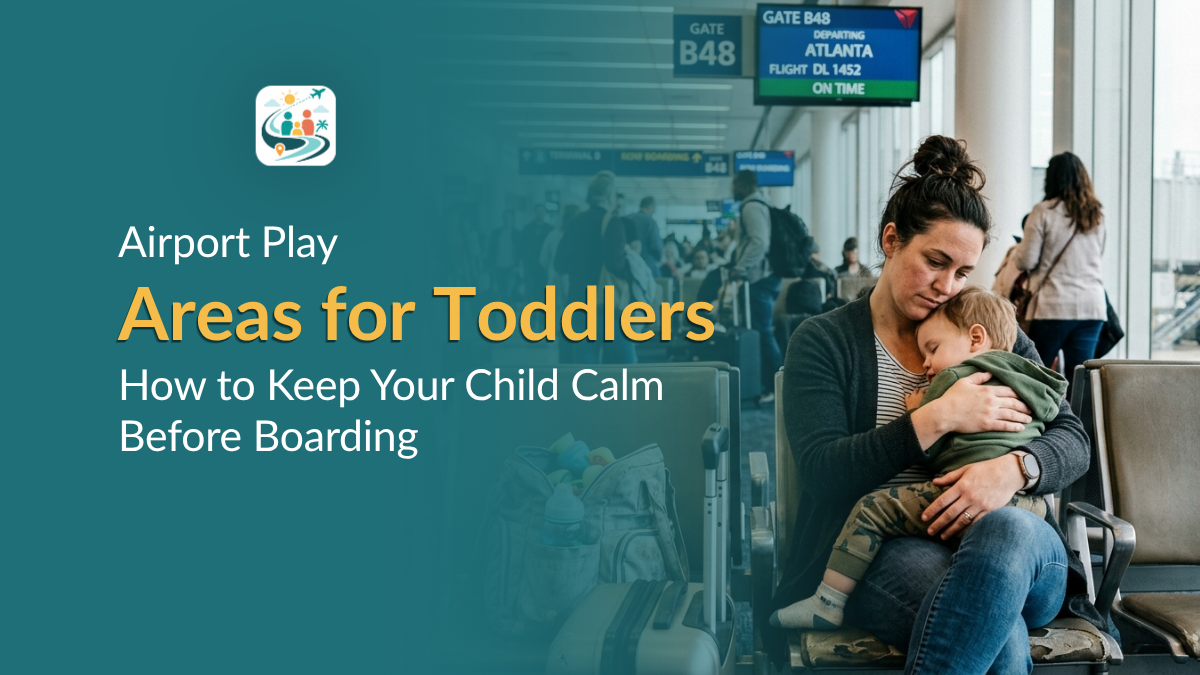
I still remember standing at the gate with my toddler after letting him run wild in the play area for nearly an hour — and watching him completely unravel right as boarding started. He was overtired, overstimulated, and absolutely done. That flight to visit my in-laws started with a meltdown in the jetway, and I kept replaying what I could have done differently. What I eventually figured out is that airport play areas for toddlers are genuinely one of the best tools you have — but only when you use them at the right moment.

Most parents aren’t dreading the flight itself. They’re dreading that 45-minute stretch at the gate where their toddler just can’t hold it together while strangers give them looks. The stress almost always begins before boarding, not in the air.
After many trips with my own kids, I learned that timing and intention are everything. Here’s what actually works.
Toddler Airport Survival Cheat Sheet
Think of airport play areas systematically as a timing tool, not just an entertainment stop.
- Best time to play: Secure your window roughly 45–75 minutes before boarding starts (ignore departure time).
- Best time to stop: Cut the session short and pull away while your toddler is still energetic and happy.
- After-play transition: Restructure their focus with a light snack, water, and structured calm time directly at the gate.
- No designated play zone? Substitute with 10–15 minutes of continuous terminal walking or structured lap games.
Why Airports Are Hard for Toddlers
Toddlers rely on routine, and airports remove routine completely. There are bright lights, loud announcements, long lines, and unfamiliar faces at every turn. Their little brains are taking in an enormous amount of sensory input all at once, which is why some kids go into overdrive and bounce off the walls while others shut down and cry. Both reactions are completely normal — and neither one is a reflection of your parenting.
The goal isn’t to stop the emotions. The goal is to manage your toddler’s energy before boarding, so you’re not trying to contain a meltdown in a crowded gate area.
What Airport Play Areas Actually Solve

Airport play areas give toddlers a safe, contained space to move their bodies — and that movement actually helps regulate their nervous system before they have to sit on a plane for hours. Think of it like a pressure valve. Without some kind of physical release, kids tend to explode the moment you ask them to sit still. But push too hard for too long, and they crash hard into an exhausted, inconsolable mess. The sweet spot is balanced energy — active enough to feel satisfied, calm enough to transition.
That balance is exactly what a well-timed play area visit can create.
How to Find Airport Play Areas Before You Travel
Don’t wait until you’re rushing through the terminal to figure out where the play area is. Do your research the night before at home, when you can actually think clearly.
- Check the airport’s official website and terminal map
- Confirm which terminal your airline departs from
- Search “[airport name] + play area” to find recent traveler photos and reviews
- Note how far the play area is from your gate
Many play areas are located post-security inside specific terminals, and some require a longer walk than you’d expect. Knowing the distance in advance means you won’t promise your toddler a play area and then have to backtrack across the airport dragging a stroller and a carry-on.
Should You Use the Play Area Right Now?
| Situation | Best Choice | Reason |
|---|---|---|
| Boarding starts in < 30 minutes | Skip | Hard to leave + risk missing boarding |
| Toddler overtired | Skip | Play may increase meltdown risk |
| Long layover | Go | Movement effectively prevents boredom |
| High energy child | Go | Best utilized 45–75 minutes before boarding (timed properly) |
When to Use Airport Play Areas (Timing Matters)
One of the most common mistakes parents make — and I made it more than once — is heading straight to the play area right after clearing security. It feels logical: your toddler is bouncing off the walls, there’s a play structure right there, and you have two hours until your flight. But if you burn all that energy too early, you’ll end up with a cranky, overtired child long before you ever reach the gate.
Instead, follow this simple sequence: play → snack → calm → board. Aim for active play starting about 45 to 75 minutes before boarding begins. Use departure time as a reference only — boarding typically starts 30 to 45 minutes earlier, so count back from there.
Pre-Boarding Timeline
Age-Based Strategy

Not every toddler uses the play area the same way, and your approach really does shift as they get older. A one-year-old needs you right beside them the whole time — they're still figuring out spatial awareness and need gentle guidance to stay safe. A two-year-old is in full-throttle energy mode and genuinely needs to run it out, so let them. By three, the challenge shifts to the transition out of the play area — building in a wind-down before you leave makes a huge difference. And four-year-olds are ready to understand what's coming next, so talking them through the airplane process step by step can help them feel prepared rather than dragged along.
Age Strategy at a Glance
| Age | Parent Focus Strategy |
|---|---|
| 1 Year Old | Stay close and guide safely. Spot them constantly; they are building physical spatial awareness and need close shadowing. |
| 2 Years Old | Let them run and release energy. Full-throttle physical movement is the goal—allow maximum active burn. |
| 3 Years Old | Slow down before leaving. Transitioning is the main hurdle here; build in a deliberate, step-down cool-down window. |
| 4 Years Old | Explain airplane steps clearly. They can absorb logical instructions; prime them step-by-step for the upcoming flight rules. |
The 5-Minute Leaving Strategy
Getting a toddler to leave a play area willingly is its own skill. Abrupt endings almost always result in a meltdown right when you need calm the most. The trick is giving warnings — real ones, with concrete language your toddler can actually understand. Countdowns with actions work far better than countdowns with numbers for this age group.
What to Say to Your Toddler
Instead of: "We're leaving now."
Say: "Two more turns, then airplane time."
Instead of: "Stop running!"
Say: "Run to the wall and back. Then we walk."
Before Boarding Checklist
Running through this list at the gate takes less than two minutes and can save you from discovering mid-jetway that someone needs a diaper change or that your toddler's beloved stuffed animal is buried at the bottom of the stroller bag.
Before Boarding Checklist
- Snack done
- Water offered
- Restroom or diaper checked
- Hands cleaned
- Comfort item ready
- Gate confirmed
Final Thoughts
Airport play areas for toddlers are genuinely one of the most underused tools in a traveling parent's toolkit — not because parents don't know they exist, but because most of us are using them at the wrong time. After years of trips with my own kids, the single biggest shift came from treating play time as preparation rather than entertainment. When you time it right and follow it with a calm wind-down at the gate, you set your toddler up to board cooperatively instead of explosively. It won't be perfect every time — travel with toddlers rarely is — but with a plan in place, it becomes manageable instead of something you dread for weeks in advance.
