


I still remember standing in the security line at O’Hare with my daughter strapped to my chest, a carry-on in one hand and my boarding pass clenched in my teeth, genuinely wondering if a TSA officer was about to ask me to undo the whole carrier — right there, in the middle of a shuffling crowd of strangers. If you’ve had that same knot-in-your-stomach moment, you’re not alone.
Traveling with a baby can feel overwhelming the second you reach airport security. You’re juggling luggage, digging for documents, trying not to wake a sleeping baby, and honestly just hoping no one asks you to do anything complicated. One question comes up again and again among traveling parents: can you wear your baby through TSA? The good news is that most parents can — and when you know what to expect, the whole process feels a lot less scary. That calm matters more than you might think. When you feel settled, your baby usually does too.
Can You Wear Your Baby Through TSA?
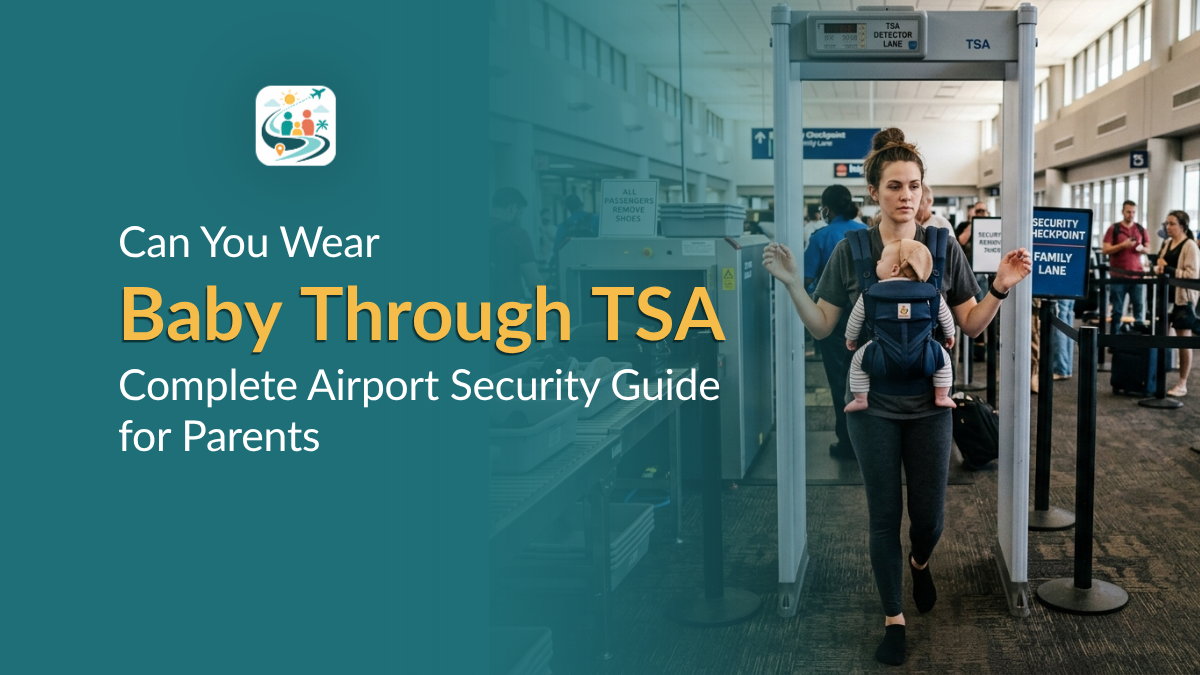
Yes, parents can usually wear their baby through TSA security checkpoints. The TSA’s official guidelines for traveling with children confirm that soft carriers are generally permitted through metal detectors.
That said, TSA officers may still perform additional screening even if no alarm sounds. This can include hand swabs, a quick carrier inspection, or a brief pat-down of the parent — none of which should alarm you. It’s a routine part of the process, not a sign that anything is wrong.
Some carriers do need to come off before screening. This typically happens when a carrier has a rigid frame or heavy metal components. TSA officers make the final call based on what the screening equipment picks up, so it helps to know your carrier going in.
Why Many Parents Choose Babywearing at the Airport
Babywearing at the airport solves problems you don’t fully appreciate until you’re actually there, managing a rolling suitcase, a diaper bag, and a wriggly seven-month-old at the same time. Here’s why so many parents rely on a carrier from curb to gate:
- Your hands stay free. Reaching for documents, loading bins, and zipping bags is so much easier when your baby isn’t in your arms.
- Babies often stay calmer. The closeness and warmth of a carrier can mean the difference between a settled baby and a screaming one — especially in a noisy, overstimulating airport environment.
- It’s easier to move. Airports are crowded, and a carrier lets you navigate tight spaces, escalators, and shuttle buses far more easily than a stroller.
If you’re traveling solo, babywearing can genuinely feel like the only way to manage everything safely without losing your mind before you even board.
What Happens When You Go Through TSA While Babywearing?
Knowing the steps in advance takes most of the fear out of it. Here is what the process usually looks like.
Step 1: Arrive at the Security Line
Keep your ID and boarding pass easy to reach — a front pocket, a lanyard, or the outer pocket of your bag works well. If your airport offers a dedicated family lane, use it. The pace is slower and officers are generally more accustomed to helping parents navigate with babies and gear.
Step 2: Prep Your Items
Place carry-on bags and personal items into the bins. You will typically need to remove shoes (unless you have TSA PreCheck), jackets or bulky outer layers, electronics larger than a phone, and any strollers or car seats. Most soft baby carriers can stay on your body throughout this step — large framed carriers are the main exception and usually need to go through the X-ray belt separately.
Step 3: Walk Through Screening
In most cases, TSA will direct you through the standard walk-through metal detector while your baby remains in the carrier. Walk slowly, follow the officer’s instructions, and don’t rush. Officers working family lanes are used to this and will guide you.
Step 4: Extra Screening (Sometimes)
Even without a triggered alarm, TSA may perform additional screening afterward. This can involve swabbing your hands, inspecting the carrier fabric, or a brief pat-down of the parent. The whole thing typically takes less than two minutes. If you’d prefer it done away from the main line, you can ask for private screening — it’s your right and a completely normal request.
Step 5: Repack and Breathe
Move to the repacking area before reorganizing. Trying to reassemble everything right at the belt while holding a baby creates unnecessary stress — give yourself a little space and a moment to reset before heading to your gate.
Metal Detector vs Body Scanner: What Parents Should Know
Most parents wearing a baby are directed through the standard walk-through metal detector, and that’s typically the simplest and fastest path. Advanced imaging body scanners work differently — parents carrying a baby cannot go through them while babywearing. If a TSA officer directs you toward a body scanner, they will ask you to remove your baby first and will walk you through the safest way to do it. Just follow their lead and know this is a normal part of the process.
Which Baby Carriers Can You Wear Through TSA?
Soft carriers with minimal metal hardware are your best bet for getting through screening without a second thought. The simpler and lighter the carrier, the smoother things tend to go.
Carriers Usually Allowed Through Screening
- Stretch wraps
- Fabric ring slings
- Soft-structured carriers
- Buckle carriers with small metal hardware
Small buckles and rings generally pass through the metal detector without issue, though results can vary depending on the specific equipment at each airport.
Carriers That Usually Must Be Removed
- Framed hiking-style carriers
- Carriers with heavy metal frames or support bars
- Large backpack-style toddler carriers
If you regularly travel with a framed carrier, plan to remove it before the belt and treat it the same way you’d treat a stroller — through the X-ray machine it goes.
TSA Rules for Strollers, Car Seats, and Baby Gear
Even when you’re babywearing, the rest of your baby gear still needs to be screened.
Strollers must go through X-ray screening. If the stroller is too bulky for the belt, a TSA officer will inspect it by hand. Fold it down before you reach the front of the line to speed things up.
Car seats also require screening. Many go through the X-ray machine, but larger or bulk models may be hand-inspected instead. Same rule: fold or collapse what you can in advance.
Diaper bags go through standard X-ray screening. TSA may open and hand-search yours if anything looks unclear on screen — this is common and nothing to worry about. Keeping items organized inside makes any secondary check faster.
Traveling With Breast Milk, Formula, and Baby Food
According to TSA guidelines for traveling with children, parents can carry breast milk, formula, and baby food in quantities larger than the standard 3.4-ounce liquid limit — a specific exemption for traveling families, not a loophole.
To make it go as smoothly as possible, store liquids in clear containers when you can, keep baby food and bottles in an easy-to-reach spot in your bag, and let the TSA officer know you have them before you start loading bins. A quick heads-up prevents confusion and speeds everything up.
TSA PreCheck and Babywearing
TSA PreCheck is genuinely worth it for parents who travel more than once or twice a year. With PreCheck, you typically keep your shoes and light jacket on, your laptop stays in the bag, and the line moves considerably faster. Parents using TSA PreCheck can usually wear their baby through the metal detector just as they would in a standard lane — the same rules apply, and additional screening can still happen when flagged, but the overall experience tends to be calmer and quicker.
How to Go Through TSA Alone While Wearing Your Baby
Solo travel with a baby is one of those things that sounds terrifying in theory and turns out to be very manageable once you have a system. A little preparation makes an enormous difference.
Before you leave for the airport, keep your documents in an easily accessible pocket — not buried in your diaper bag. Loosen your carrier straps slightly so they’re ready to adjust if needed. Pack all baby liquids into a separate pouch you can pull out without unpacking everything, and use a backpack instead of a shoulder bag so your hands stay as free as possible.
At the belt, load your heaviest items into the bin first, then your smaller items on top. This keeps things stable and moving quickly, and means you won’t be fumbling with a lopsided bin while a TSA officer waits on the other side.
How to Prepare Your Carrier Before Security
A two-minute check before you hit the security line can prevent delays and unnecessary back-and-forth with TSA officers. Remove any dangling toys or accessories that might trigger a second look. Check for loose straps or buckles that could snag on the belt. Try to avoid wearing metal-heavy jewelry or clothing right around the carrier area, and make sure your baby is in a safe, supported position before you approach the checkpoint — so you’re not trying to adjust mid-screening.
Hygiene and Safety Tips After TSA Screening
Airport security bins are notoriously germy — one of those travel realities worth thinking about when you’ve got a baby in your arms. After clearing screening, sanitize your hands before touching your baby’s face or any feeding items. Wipe down pacifiers and teethers that may have touched surfaces. Give the carrier fabric a once-over if it had contact with the belt, and if any baby items dropped on the floor during the process, replace them rather than wiping them down — it’s just not worth the risk.
International Airport Security Differences
Most international airports permit babywearing during security screening, but the rules and procedures aren’t identical everywhere. Some countries ask parents to remove babies from carriers more frequently as a standard practice. Others may have additional screening steps or different equipment that interacts with carriers differently than you’d expect.
If you’re flying internationally, build in extra time before your departure. Arriving earlier gives you breathing room if security takes longer than expected, and going in prepared for the possibility of more steps means you won’t be caught off guard.
What If TSA Asks You to Remove Your Baby?
Occasionally, a TSA officer will ask you to take your baby out of the carrier. This usually happens when an alarm sounds, when additional screening is required, or when the carrier contains metal or rigid components that need to be inspected separately. It doesn’t happen often, but it does happen.
If it does, stay calm. Hold your baby securely and let the officer screen the carrier. Remember that you can always request private screening if you’d prefer not to do this in the open security area — officers are required to honor that request.
Additional Support for Families Traveling With Babies
If your child has special needs, uses medical devices, or you’d simply like extra assistance at the checkpoint, you can request support in advance by contacting your airline or the airport directly. TSA also has a helpline (TSA Cares) specifically for travelers who need additional support – Call TSA Cares at 1-855-787-2227 at least 72 hours before your flight.
. Arranging help ahead of time rather than on the day makes a real difference in how smoothly everything goes.
Tips to Make TSA Security Easier With a Baby
These are the things that consistently help parents get through security without a meltdown — theirs or the baby’s:
- Choose a soft carrier with minimal metal hardware
- Arrive early to allow time for any additional screening
- Wear comfortable clothes and shoes that are easy to take off
- Pack all baby liquids together in a separate, accessible pouch
- Keep your ID and boarding pass in an outer pocket you can reach immediately
- Stay calm and follow TSA officer instructions — your energy sets the tone
Frequently Asked Questions
Usually, no. Parents can often keep babies in soft carriers while passing through metal detectors. TSA may request removal in certain situations.
Yes. Parents using TSA PreCheck can usually wear their baby through screening, but extra screening may still occur.
No. Airlines require babies to be removed from carriers during takeoff, landing, and turbulence for safety reasons.
Before You Head to the Airport
Babywearing is genuinely one of the easiest ways to move through airport security with a baby — and once you’ve done it a time or two, it starts to feel second nature. Most parents can keep their baby in a soft carrier through the metal detector, and if extra screening happens, it’s typically quick and straightforward.
The biggest difference between a stressful TSA experience and a calm one usually comes down to preparation. Parents who have their documents ready, pack baby liquids in a separate pouch, and choose a simple soft carrier tend to move through security with confidence. And that confidence really does trickle down to your baby. When you know what to expect, you can stop worrying about security and start thinking about the trip ahead.
